
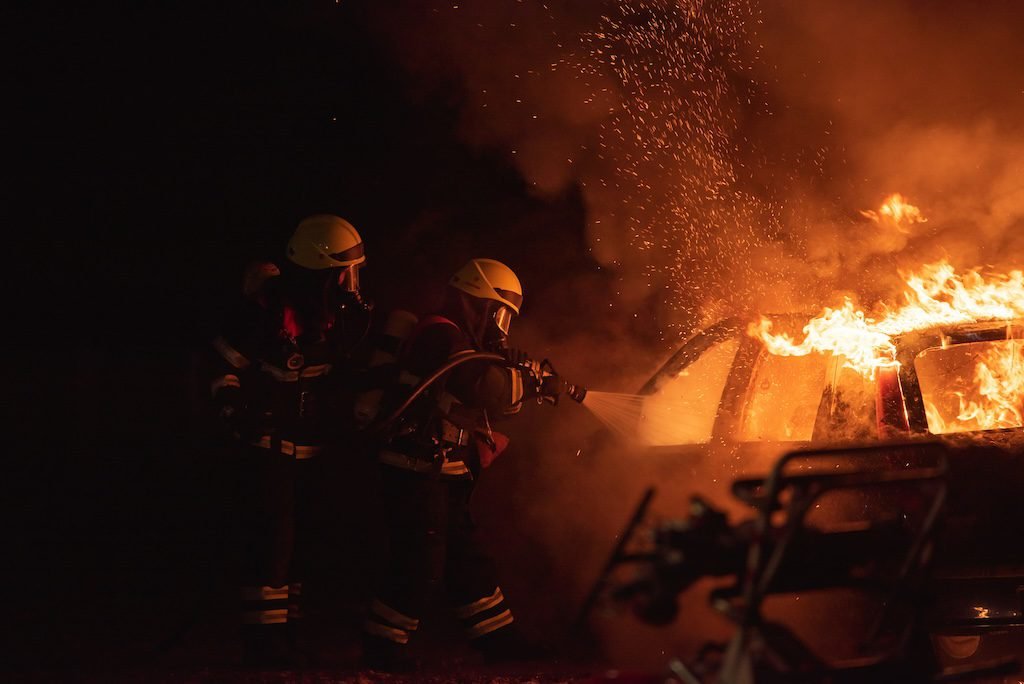
When a sprinkler valve fails or a fire alarm goes offline, the clock starts ticking immediately. Building owners face a narrow window to comply with fire codes, and missing that window carries consequences that range from heavy fines to a full building closure order. Fire watch security is the temporary but critical human solution that bridges that gap, placing trained guards on-site to monitor for fire hazards until systems return to service.
At ATA Guards Security Provider, we deploy certified fire watch officers around the clock, every day of the year. Here is everything you need to know about this essential service.
What is fire watch security?
Fire watch security is a human monitoring solution activated when a building’s fire protection systems, such as sprinklers, alarms, or suppression equipment, become impaired or fully offline. Instead of leaving the property unprotected, trained officers patrol the premises at timed intervals to detect smoke, heat, or fire at the earliest possible stage.
The National Fire Protection Association sets clear mandatory timelines. Under NFPA 72, fire watch must begin within 4 hours of a fire alarm system failure. Under NFPA 25, a sprinkler system impairment triggers the requirement within 10 hours. Missing either window puts your property out of compliance and places every person inside it at real, documented risk.
When does a building require fire watch?
Most property managers think about fire watch only after something goes wrong. In practice, several situations trigger the requirement, and knowing them in advance allows you to respond fast instead of scrambling under pressure.
- Sprinkler system impairments: Pipe breaks, valve closures, or maintenance shutdowns taking any zone offline
- Fire alarm failures: Total outages, zone faults, or trouble conditions affecting detection circuits
- Hot work operations: Welding, cutting, grinding, or torch work where combustible materials sit within 35 feet
- Buildings under construction: Structures over 40 feet tall without complete fire protection systems in place
- Special events and festivals: Temporary setups with cooking stations, propane, or pyrotechnic displays
- Planned maintenance shutdowns: Scheduled system upgrades or mandatory inspection periods
Each scenario carries its own compliance rules. Hot work fire watch, for example, must continue for at least 60 minutes after work stops, because sparks smolder inside walls and insulation for hours before igniting visible flames.
What fire watch security guards actually do
A fire watch officer is not a standard security guard standing near a lobby door. Their sole assignment is monitoring for fire, and nothing else. This “sole responsibility” rule is written directly into fire codes because distracted guards miss fires, full stop.
Here is what a professional fire watch officer from ATA Guards handles on every single shift:
- Timed patrols at intervals set by the local Authority Having Jurisdiction (AHJ), whether 15, 30, or 60 minutes depending on the occupancy type
- Systematic area coverage including mechanical rooms, stairwells, storage areas, exit corridors, and roof access points
- Portable fire extinguisher readiness: Every officer carries a 2A10BC-rated unit and knows precisely when to use it
- GPS-verified digital logging of every patrol with timestamps that satisfy fire marshal and insurance audits on the first review
- Immediate fire department notification the moment any sign of smoke, heat, or ignition appears
- Work stoppage authority during hot work operations when unsafe conditions develop, with no exceptions
“A fire watch guard is the last line of defense when technology fails. Their eyes, ears, and judgment cannot be replaced by sensors or cameras. That is why codes demand human presence, not hardware.”
Fire watch security compliance: the rules you need to know
NFPA standards and what they require
The rules governing fire watch come primarily from NFPA standards, which most local fire codes adopt and enforce. Three standards shape day-to-day practice more than any others.
NFPA 72 covers fire alarm impairments and mandates fire watch within 4 hours. Guards must patrol at intervals no longer than 30 minutes through all areas served by the impaired detection system.
NFPA 25 governs sprinkler system failures and gives building owners a 10-hour window before fire watch is mandatory. However, many insurance carriers require immediate deployment regardless of what the code allows, so reviewing your policy before assuming that window is available is essential.
NFPA 51B addresses hot work operations. It requires a dedicated watch during welding, cutting, and grinding, plus a mandatory 60-minute post-work period because delayed ignition inside structural materials is a documented and repeated cause of catastrophic losses.
Patrol intervals by occupancy type
Not all buildings require the same patrol frequency. The interval depends on who is inside, how quickly fire could spread, and how difficult evacuation would realistically be:
- 15 minutes: Hospitals, nursing homes, hotels, and assembly venues with high occupant loads or sleeping guests
- 30 minutes: Standard office buildings, retail stores, warehouses, and most commercial occupancies
- 60 minutes: Vacant buildings with minimal combustible content, only when the local AHJ explicitly approves this reduced frequency
Your local fire marshal sets the final patrol requirement. Assuming 30 minutes is acceptable without confirming with your AHJ can result in a code violation even when every other element of your fire watch is done correctly.
Hot work fire watch: a separate and specialized role
Hot work ranks among the leading causes of preventable fires in commercial and industrial buildings. When workers weld, cut, or grind, sparks travel up to 35 feet and embed in insulation, drywall, or roofing material, smoldering silently for hours before visible flames appear.
ATA Guards hot work fire watch officers enforce the 35-foot clear zone under NFPA 51B, verify that Class ABC extinguishers are in position before work starts, and monitor both the immediate work area and adjacent spaces throughout every operation. After the crew stops, the watch continues for the full mandatory period because the risk does not end when the torch goes cold.
Our officers coordinate directly with the Permit Authorizing Individual (PAI), who must approve all hot work before it begins. If unsafe conditions develop at any point during operations, our guards carry full authority to stop work immediately and document the reason in the compliance record.
How ATA Guards delivers fire watch security
At ATA Guards Security Provider, our service is built around three priorities: speed, documentation, and reliability.
Speed matters most in emergencies. We deploy fire watch officers within 2 to 4 hours of your call, including nights, weekends, and holidays. When NFPA compliance clocks are running, waiting until the next business morning is not an option.
Documentation protects you from every direction. Every patrol is recorded with GPS-verified digital timestamps. You access real-time patrol records through our client portal, and we generate audit-ready compliance reports on demand. Fire marshals and insurance adjusters consistently accept our digital records without dispute.
Reliability is non-negotiable. Our officers are licensed, background-checked, and trained in NFPA 101, NFPA 51B, and OSHA 1910.252. They perform no other duties during fire watch shifts. You receive dedicated life safety coverage, not a guard juggling five unrelated responsibilities simultaneously.
Fire watch coverage for specific building types
Different buildings present genuinely different challenges, and ATA Guards approaches each one accordingly.
Hospitals and healthcare facilities require 15-minute patrols across all patient care areas, fully coordinated with nursing staff to account for non-ambulatory patients and life support equipment that cannot be interrupted.
Construction sites receive coverage under NFPA 241 for structures exceeding 40 feet, with officers trained in construction-specific hazards including temporary heating equipment, combustible debris accumulation, and incomplete suppression systems.
Hotels and residential buildings get night patrols focused on sleeping guests who are unfamiliar with the building layout, combined with systematic verification that all fire doors remain closed and exit routes stay clear throughout the shift.
Special events start with a full pre-event inspection of cooking stations, propane setups, and temporary electrical runs, followed by continuous patrol through the event and a thorough post-event sweep for any smoldering hazards left behind.
The real cost of skipping fire watch
Some building managers delay fire watch to cut costs. The math rarely works in their favor.
Regulatory fines vary by state, but the numbers move fast. Florida statute runs $1,000 per day per violation. Federal OSHA serious violations reach $16,131 per incident. New York City Class 1 fire code violations carry fines from $1,000 to $5,000 plus potential criminal misdemeanor charges. Each day out of compliance adds a separate count.
Beyond fines, the larger risk is a complete insurance claim denial. Most commercial property policies contain provisions that void coverage when documented safety violations exist at the time of a loss. A fire during an unprotected impairment can result in the carrier refusing to pay a multi-million-dollar claim, leaving the building owner to absorb the full damage.
Professional fire watch from ATA Guards costs a small fraction of a single day’s regulatory fine, and far less than one percent of an uncovered property loss.
Ready to deploy certified fire watch coverage?
Fire watch security is not discretionary when your systems go down. It is the code-mandated protection that keeps your occupants safe, your insurance policy valid, and your building legally open for business.
ATA Guards is ready to dispatch a certified team to your location, day or night. Contact us today for a fast quote and same-day deployment for emergency impairments. Your building faces real risk the moment protection systems fail, and so does everyone inside it.

